Rose tinted 70s spectacles
Ah, the good old days! The golden era!
Regardless of how aware we might be of our natural tendency to nostalgically distort memories of days gone by, it’s increasingly hard — especially when living through times of tribulation — not to look back on our past experiences through rose-tinted glasses.
Many — myself included — can even be lulled into reminiscences of times we never really knew from before we were even born: taken in by the sheer otherness of it; that sense of familiar-but-different that makes us yearn for a nostalgic heyday we only ever experienced through television reruns and old movies.
Rewatching shows like ‘The Good Life’ in my role as show host for my podcast — the Sitcom Archive Deep Dive Overdrive — I recognise my own recent family history. I guess it’s why, like so many, I naturally feel a warm and cosy affinity with the show.
Through my rose-tinted, backwards-glancing spectacles, I can see an aunt’s chintzy front room furniture in Margo and Jerry’s settee. I can smell the smoke of a parent’s 40-a-day habit in the scenes with Jerry’s after-work gin and tonics. The knick knacks and ornaments in the characters’ homes can be placeholders for accessing memories.
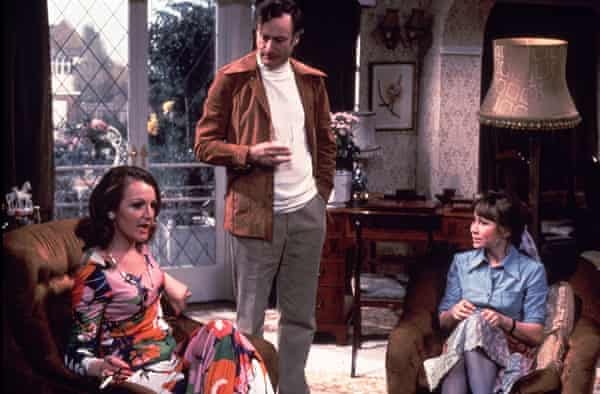
This is a sense of home that never existed in reality. My recollections of the Good Life era are almost exclusively second hand, absorbed through the Chinese-whispered stories of a close-knit family, or a collection of old photographs housed in albums of varying states of decay. I have only ever viewed the show as a repeat, initially through the eyes of a child of the 80s (a good 10 years after the programme first aired), watching stories unfold that I struggled to fully understand at the time, but would happily rewatch over and over.
The slapstick prat-fall of Margo in a sou’wester and the running around and general silliness of Tom and Barbara kept me coming back. The titular Goods seemed excitable and childlike, appealing both to 1980s little-me and the child within me now: my love for the show undiminished.
While television itself remains as popular as ever, the parameters of watching television have altered greatly over the past 40 years. Where once the nuclear family would sit around a huge box in the corner of a front room trying to decide between just three channels; the modern TV addict can be overwhelmed by choice thanks to the countless platforms boasting a veritable smorgasbord of options, all accessible through a screen kept in your pocket. This is a future ‘Tomorrow’s World’ wouldn’t have dared to dream!
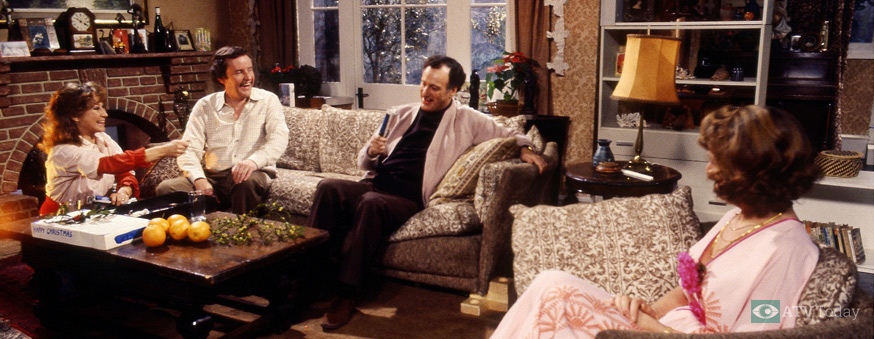
Like most children of the 1980s, I had to watch whatever the rest of the family were watching. Grand shows and ‘specials’, especially episodes aired around Christmas time, were a huge event: you laughed when your dad laughed and you laughed at your dad laughing, without ever really understanding why.
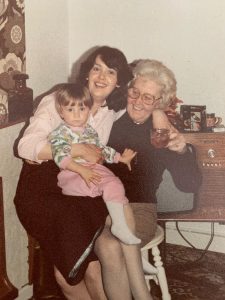
My Nana, my Mum and me
Countless rewatches through the years allowed me to unpick the comedy and discover exactly what it was about that particular word, glance, or the flow of a sentence that made it funny. Shows like ‘The Good Life’ shaped and guided my humour; I often imagine showing my parents and grandparents things today that have made me laugh and I know they would have enjoyed them too, through this shared cultural connection.
The mere thought of ‘The Good Life’ transports me instantly back to time spent with my grandparents and the period they existed in my life as a couple, from 1979 to 1993 — albeit a brief sliver of their own existence. Rewatching television shows I watched around then, ‘The Good Life’ being a wonderful example, offers a metaphorical DeLorean ride back to their riddled-with-the-1970s front room.


 Apple Podcasts
 Google Podcasts
 RSS
RSS Spotify
 Stitcher
 Podbean
 TuneIn
 RedCircle
 YouTube
 iHeartRadio
Margo Leadbetter: Elegant, Timeless Fashion Icon
Regularly voted one of the best sitcom characters ever created, the appeal of The Good Life’s Margo Leadbetter is an enduring one. Approaching 50 years since Margo first graced our screens — floral print mumus, kaftans and colourful headbands to the fore — her appeal as a comedy creation and a fashion icon, has never diminished.
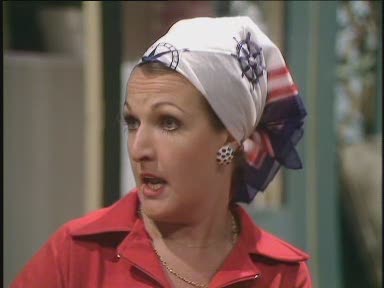 In my role as co-host of the Sitcom Archive Deep Dive Overdrive podcast, I take a weekly trip over to ‘Fashion Corner’ to appraise the fabric fabulousness of the 1970s as modeled by Margo. It’s a regular part of the show, as we work our way through each episode, forensically deconstructing everything from the comedy, writing and performances to the fashions and vernacular of the time .
Fascinatingly, the costume budget for the show, which ran from 1975 to 1978, was placed almost entirely in the clutch bag of actress Penelope Keith to spend along London’s home of fashion, Regent Street.
Speaking at the Cheltenham Literature festival in 2011, Keith revealed that there was a real fear amongst the production staff that unless the full costume budget was spent, it would be cut.
The characters of Tom and Barbara required little attention from the costume department, saving the production a small fortune by continuously re-wearing the same garb for all four series; fixing and stitching any issues, just like the Goods. As the show progressed, Margo’s rewearing of pieces became few and far between, with new dresses, hats and jackets introduced in each episode.
We see a great deal of flowing, maxi dresses and evening gowns; whatever the event, Margo dresses for occasion and aspiration. The old adage ‘clothes make the man’ (or woman), is appropriate to describe one of Surbiton’s leading lights.
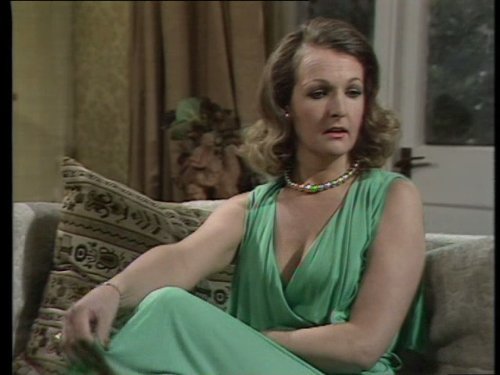
Never do we see Margo slobbing around the house in athleisure wear. Quite the opposite: she is often dressed up to the nines for such simple pleasures as an afternoon G&T in the living room with Jerry. Each hobby requires an element of couture in crafting a uniform, and while riding with the Pony Club, Margo is fully kitted out in pristine jodhpurs, helmet and hunt coat.
An irrepressible snob (but one with a big heart), Margo is variously appalled that Barbara no longer has cause to dress up, now that the Goods have left the consumerist lifestyle of the rat-race and embarked on a journey of self sufficiency. Margo pities Barbara and considers her brave for giving up a facet of life that she feels is evidence of one’s status in society.
Of course, Barbara is more than willing to give up that frivolity – despite a tinge of resentment setting in on the odd occasion, no doubt magnified by Margo’s ostentatious attire.
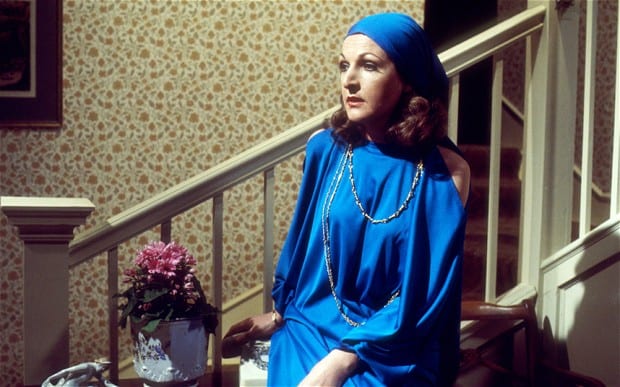
Margo’s knack (or rather Keith’s aptitude) for matching up garments and accessories is very much on display. The clothes take on a life of their own and really do highlight the character’s attitude towards looking one’s best. Headscarves, hats, floral brooches and bangles complete many an ensemble, displaying with a flourish the opulence of the Leadbetter’s middle class existence.
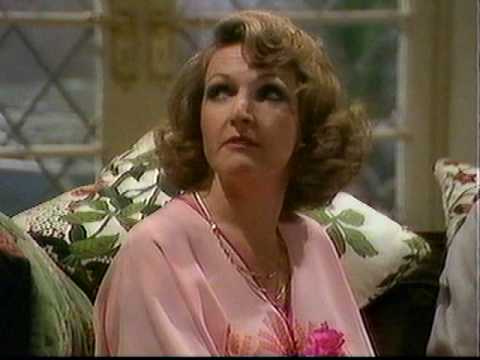
In early episodes, Margo’s wardrobe embraces the typical seventies palette of purples, greens and oranges — vibrant, often gaudy combinations of prints and shades — paisley, geometric and florals. As time ticks by, later series show Margo following the trend of earth colours – rich browns, creams and yellows, and Laura Ashley designs.
Contrastly, Barbara’s only real chance to escape the drudgery of her self-sufficiency wardrobe is her floaty, floral “posh frock” — representing the last vestige of her life as a middle-class house wife in The Avenue.
The dress gets an airing in the first series when Tom takes Barbara out for dinner (a kind of last supper), and then again at the end of series three when she is feeling unnoticed by Tom and frustrated at no longer being seen as a woman. Donning the dress to seduce Tom, her self-serving husband is oblivious to her feelings and tragically, she tears the dress mid-flounce! This compounds Barbara’s anger and sadness, although Tom assures her that she doesn’t even need to consider those things anymore. Things go from bad to worse when glamorous dinner guest Eileen (an old friend of Barbara) arrives dressed to the nines in a beautiful pistachio-coloured halter neck satin dress, reducing Tom to a snivelling flirt.
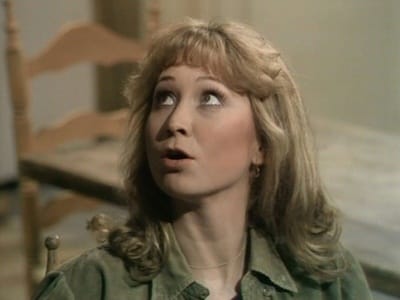
Tom does eventually realise the depth of ill feeling and apologises to his wife with a gift of a new posh frock — a stunning cream, halter neck, full-length dress. With dainty flowers embroidered around the neck, and nipped in at the waist, this dress makes a definite statement about Barbara’s femininity, and holds its own against any of Keith’s wardrobe selections.
Despite a relative lack of costume curation for Barbara, her day-to-day work clothes have an understated, utilitarian elegance to them, thanks in large part to Felicity Kendal. She may have been the inaugural winner of ‘Rear of the Year’ but she can certainly rock a pair of mucky overalls! Teamed with a black polo neck top, a head scarf and a pair of chunky black glasses, the character of Barbara has titillated generations since 1975 and herself remains a fashion icon.
A regular ‘Fashion Corner’ mention, Jerry’s jacket and slacks are similarly iconic representations of late 1970s male fashions. While he is suited and booted for work at the drawing board, casual Jerry often dons his tan leather jacket and checked slacks for leisure – whether entertaining guests, enjoying afternoon G&Ts or encouraging local businesses to part with their wares in return for promotion in the Observer.
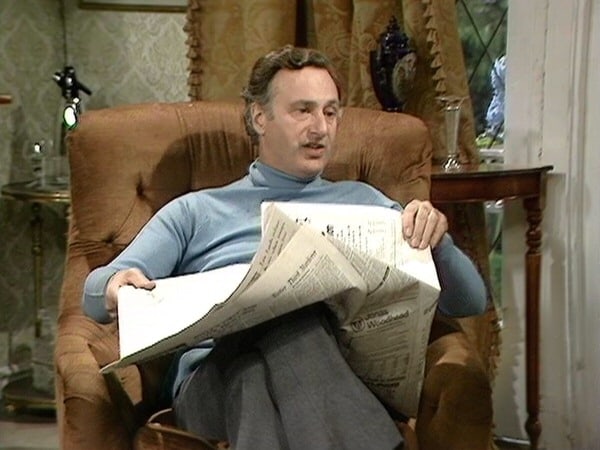
Paul Eddington’s Jerry is the archetypal man about town, and cuts a dashing figure. Even his Mr Rogers-esque red cardigan — which would look decidedly naff on many men — gives Jerry a wise and mature air, while doubtless giving Margo a chance to have the leather jacket dry cleaned.
Tom Good, played by Richard Briers, is the least dynamic in the wardrobe department, and often gets overlooked in Fashion Corner. Following his life-changing decision to resign from his upwardly mobile career as a draughtsman, Tom’s wardrobe changed radically. Out went the suits, and shiny shoes, and in came the perennially moth-eaten blue jumper and anorak.
Tom even repurposed his old dinner jacket as working clothes, to be used while creosoting the fence!

Tom did show his good side, however, when he sold his best suit and expensive watch to buy Barbara the aforementioned new posh frock. Any attempt by Tom to hoist himself aboard the winner’s podium at Fashion Corner is met with a swipe of the hand (especially by my co-host, who has what borders on a pathological hatred for the character!)
Sadly, even when Tom tries to break free of the sartorial limitations enforced on him by a self sustainable life, he misses the mark, evidenced by his going ‘double denim’ in an episode where he is gifted free clothing by a local business! Tom’s attempt to cat walk around the kitchen is slightly uncomfortable, like a 40 year old dad not coping well following a particularly messy, mentally scarring divorce.
Tom’s double denim faux pas aside, the show’s eclectic fashion selections still very much stimulate modern day admiration and imitation. The wardrobe on The Good Life is almost a character in its own right, and it’s no wonder that the show continues to both delight viewers and inspire fashions to this day.
Subscribe to the SADDO podcast wherever you listen to your podcasts, or listen in your browser at https://saddo.club to hear me discuss the enduring fashions of the show weekly.
Alison
The Sitcom Archive Deep Dive Overdrive is a brand new podcast that week by week, delves into every episode ever made of our favourite situation comedies.
Starting with all 30 episodes of ‘The Good Life’, SADDO can be found wherever you listen to podcasts.
Self Sustainability and Living The Good Life
Way back in 1975, self-sustainability was firmly introduced into the mainstream consciousness via the medium of the great British sitcom; fanfare please for the arrival of BBC comedy, ‘The Good Life’.

The series, which ran until 1978, leads the audience through a journey sparked by an idea conceived by its central character — 40-year-old Tom Good — to quit the rat race in favour of a fully-functioning, self-sustainable lifestyle, complete with pigs, crops and a homemade generator. The Goods take the decision to rely only on their own ability to produce what they need, and sell or swap what they don’t. They use their own skills, wit and initiative to achieve their goals, overseeing many obstacles along the way; some achievement for a former draughtsman whose 9-5 had, until recently, consisted of an office drawing board, liquid lunches and the Sunday night back-to-work terrors.
What we know as the alternative 3Rs today – reduce, reuse, recycle – were already watchwords of the post-war public. “Make do and mend” was still a common mantra, borne of necessity in a time where rationing and austerity were all too recent memories. As the 1970s progressed, so did the increased use of man-made products and perhaps the advent of what we know as ‘throw away culture’.


Recycling, reusing, repairing and donating can feel like a drop in the ocean when you’re going about your life but even minor changes can help.
In contemporary society, taking care to look after the planet and conserve energy is not only par for the course, it’s admired and respected. Most people accept that we need to work together to support the future of the planet and conserve its resources, with saving money through sustainable-living a welcome by-product.
Whilst in 2020 we largely know and accept the need to make a significant contribution to the effort, back in 1975 the self-sustainable life of the Goods put them firmly on the fringes, making them social pariahs and a bit of a laughing stock on ‘The Avenue’.
It’s fair to say that the Goods were pioneers (albeit fictional ones) — but back in the time of The Good Life, were audiences in the 70s and 80s influenced to adopt a more ‘Good Life’ approach to sustainability from watching the sitcom? Or did it seem so far fetched and ‘hippy’ that it was only ripe for ridicule.
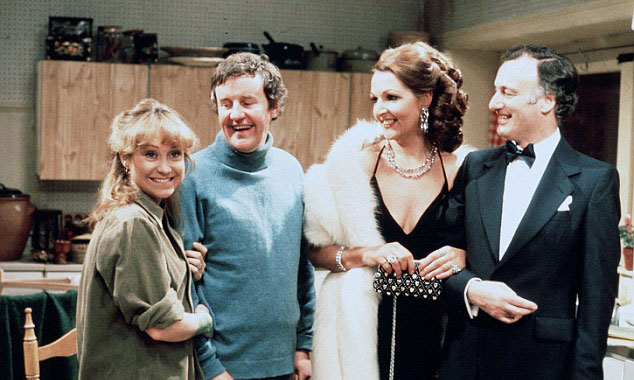
The Good Life contained a lefty concept at a time when, politically, capitalism was where it was at. It was during the latter series that Thatcher took her place as one of the most divisive PMs in recent history. I strongly suspect she would have condemned the Goods for being unwashed and lacking in traditional morals.
In 2020, we can still learn so much from The Good Life, such as how to maintain a friendship with people who have opinions that are poles apart from our own. The Goods and Leadbetters might not live in harmony, but they are still supportive and loving to one another. In today’s polarised world, it might do for us all to take a leaf out of the book of the Good Life.
The benefits of slow fashion – advocating the mending, making and reusing of clothes – is a concept urging the move away from shopaholic tendencies and landfill. This was perhaps something more forced upon Barbara than her willing choice; one of the first things to go was her clothing budget. But a positive move nonetheless.
Undoubtedly, coming ‘off grid’ was a simpler prospect in the 1970s. With life revolving around the wifi router nowadays, we are urged to undergo a digital detox every so often. Even a short term adherence to this is good for us, but with a huge amount of our lives maintained online now – from banking and business to even our social lives through the pandemic – how easy and realistic is this today?
We’d love to hear from real-life sustainable living enthusiasts who have taken the plunge, inspired by the efforts of Tom and Barbara. We’re on social media (Facebook | Twitter | Instagram) and can be contacted at [email protected]
Alison
The Sitcom Archive Deep Dive Overdrive is a brand new podcast that week by week, delves into every episode ever made of our favourite situation comedies.
Starting with all 30 episodes of ‘The Good Life’, SADDO can be found wherever you listen to podcasts.
Lovely Barbara Good and her awful, awful man-child husband, Tom
Ask any heterosexual male who grew up on repeats of ‘The Good Life’ what the main appeal was to the gentle, suburban situation comedy, and it’s frankly unlikely you’ll receive many answers without a mention of ‘Barbara’ or ‘Felicity Kendal’.

The Good Life, which ran on BBC1 from 1975 – 1978, was what would today be known as a ‘sleeper hit’, attracting a modest audience (for the time) of around 8.2 million viewers during the first series. Of course, this was in the days when there were only three channels, meaning the great British public’s choice was less diluted.
An act of serendipity — an ITV strike in 1976 which coincided with the broadcast of the second season (objectively also the shows finest) — resulted in viewing figures sky-rocketing, eventually reaching a massive 21 million for the 1977 Christmas special. A cult hit was born.
Amongst the myriad of eager viewers, I was one of many pubescent males who found himself helplessly fixated by the charms of Felicity Kendal’s Barbara: the tom-boy wife to Richard Briers’ Tom Good, nominally the central character of the piece.
The show’s central arc — Tom and Barbara’s odyssey into a radical new lifestyle of self-sufficiency — provided a flexible framework for comedic storylines, augmented by good-natured conflict with the conservative next-door Leadbetters. Yet it was Kendal’s portrayal of Barbara as a feisty-but-fun, pixie-like sexpot that kept me glued to my screen.
Growing up in the 80s, the seemingly never ending repeats held my attention. Whilst enchanted by the gentle humour and comforting familiarity of the show, it was Barbara that had truly captured my heart.
Not that Barbara’s appeal was entirely sexual in nature. Tom and Barbara’s almost child-like playfulness and frivolity was, and remains, an endearing recurring trope of the show. The Goods embraced their inner silliness wherever possible — frolicking in the fountain or flinging food at one another — sharing a sense of puerile fun that seemed to my young eyes to represent the perfect manifestation of a marriage. They rejected the fuddy-duddy adulthood of their peers (such as Tom’s supercilious former boss, ‘Sir’) in favour of…..well, mucking about!
Spending the day working at home with his missus on their joint passion-project, joyfully dicking about being daft before being tempted up to the boudoir by a quick bat of her beautiful brown cow-eyes or a cheeky wiggle of that pert bottom; it seemed to me that Tom Good was the luckiest imaginary bleeder in the whole darn-tooting fictional TV world.
Of course, Felicity Kendal was (and remains now, in her 70s) a singularly beautiful woman. Latterly considered a ‘national treasure’ by the seemingly anonymous force that bestows the title, Felicity has been the subject of many journalistic profile pieces through the years, and it seems is at pains to point out the marked differences between the character that made her famous and her own personality.
It’s perhaps testament to her acting prowess that Felicity was able to so convincingly pull off the role of cutesy, dedicated but feisty wife to her maddeningly irritating husband Tom, whilst all the while the actress herself lived a life of determined independence. Talking to the Guardian in 2015, Kendal elucidated:
“No, I’m not obedient and nice and do what I’m told at all. I’m totally and utterly independent. On the other hand, I’m not a steaming women’s libber in the caricature sense. A lot of women do have that image because they have a very intellectual front, are very outspoken and say a lot of very frightening things.”
It would have been an interesting prospect to see how the titular Tom Good would have coped with marriage to a freer spirit than “good old Barbara”, as he often refers to her. Had Felicity Kendal been tasked with bringing more of her own personality to the role, I’d like to think that the first things Barbara would have knocked on the head might have been Tom’s incessant, enraging whistling, as well as his constant, attention-seeking noise-making.
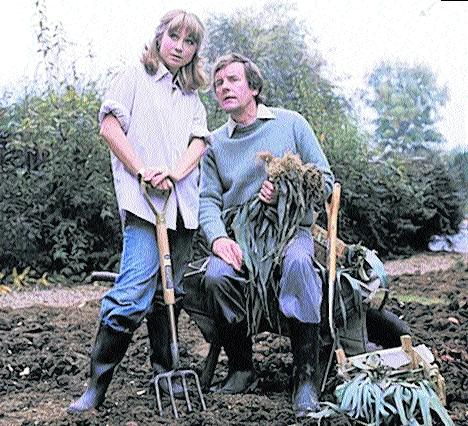

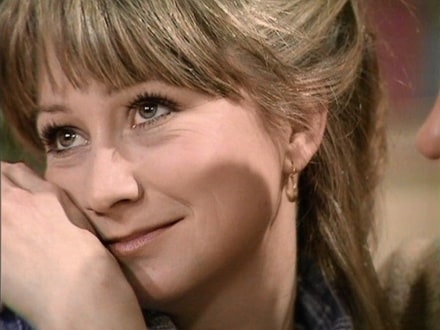
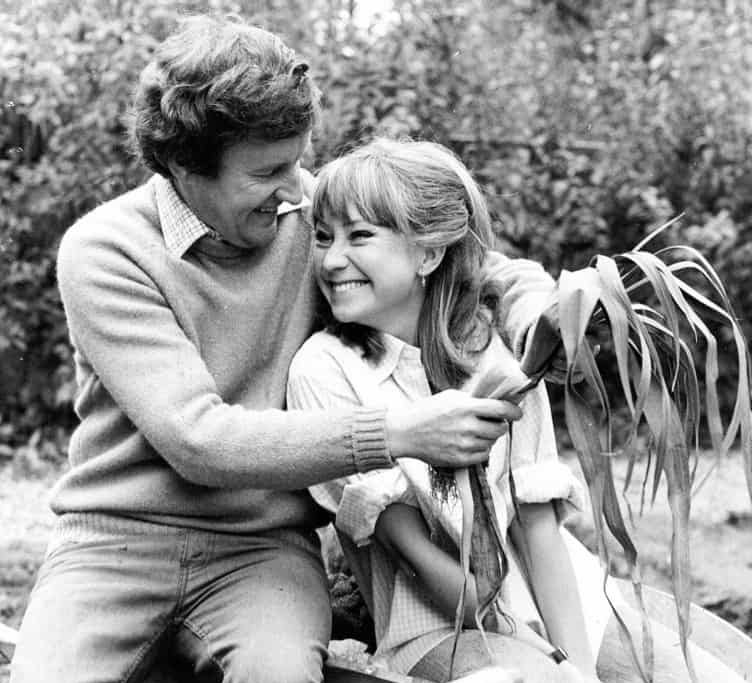
It’s not that Tom is without his good points: quite the contrary. Like Barbara, Tom is loyal, hard-working and enthusiastic (irritatingly so), as well as honest, to a point (at least when it matters). And of course, the character is played expertly by the eminently likeable Richard Briers, every 80s kid’s favourite imaginary uncle!
So why does he come across as such an arse?
Well, as Briers himself pointed out many years after the show had aired:
“I never really liked Tom. I thought he was selfish and obsessed. Poor Barbara never got any dresses and presents. It was always about him, his ideas, his plans.”
‘Dicky’ (to his mates) gets stuck into Tom further in another retrospective, referring to the character as a “parasite” and a “leech”.
Whilst it’s fair to say there is probably an element of #differenttimes to Briers’ reading of Tom — in truth, Barbara was equally opposed to wasting funds on luxuries — his characterisation of Tom as a parasitical scrounger certainly stands up to inspection.
Jam-packed with hubris and immensely self-satisfied with his eco-warrior lifestyle change, Tom’s bonhomie masked the truth (perhaps even from himself) that he rarely lived the sustainability lifestyle in the truest sense. He repeatedly relied on the charity and good-will of the kind-hearted Leadbetters, who over the show’s four short series provided hand-outs, lifts, loans and manual labour: the latter something Jerry wilfully gave to find some respite from his own high-maintenance spouse.
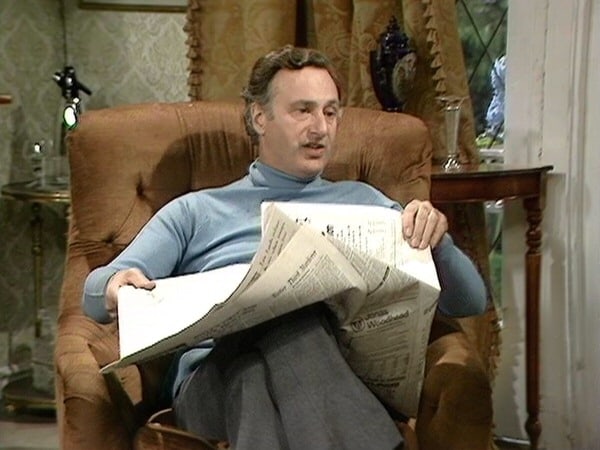
During our obsessive analysis of each and every episode ever made of The Good Life here at the Sitcom Archive Deep Dive Overdrive podcast, I’ve been waging an anti-Tom propaganda campaign of sorts, aimed at convincing my co-host Alison Barton-Simmons that Tom is, in essence, a tit. This needy, sulking man-child not only takes his neighbours for granted, he frequently acts with an almost Millennialesque-level of entitlement when it comes to putting-upon his loyal friend Jerry. If Jerry wasn’t so perennially sozzled he’d probably have flipped his lid!
I think I’m winning her over, especially given our most recent re-watches come through the prism of 21st century values and a more increased focus on equality. Another of Tom’s infuriating tendencies is his proclivity for gas lighting Barbara and taking credit for her ideas, although in fairness it is played with a twinkle in the eye by Briers, as if to indicate that both parties are in on the joke that Tom is an insufferable blowhard.
I’ve observed that a common failing in the writing of many television shows (comedic and otherwise) since the turn-of-the-century has been the inability to craft characters the audience can emotionally relate to. I’ve lost count of the number of shows I’ve given up on simply because I felt there wasn’t a single likeable person present on screen at any time.
Which brings me to my reluctant concession when it comes to Tom Good.
Despite all the accusations I’ve levelled at the bloke, both here and in shouting at my TV through the years like a lunatic, Tom is essentially redeemable. The quality of the writing on ‘The Good Life’, courtesy of sitcom royalty Bob Larbey and John Esmonde, is of such imperious quality that for all Tom’s theatrics and flaws, he nearly always contrives to see the error of his ways, meaning that the audience – even an old cynic like me – can root for Tom and Barbara throughout (albeit a good deal more for Barbara, in my case).
Finally, don’t let my vitriolic contempt for Tom fool you. Watching the show has always been a pleasure and never more so than now, for the umpteenth time but through a slightly different lens, as we obsess and micro-analyse the minutiae of the show knowing we’re going to have to talk about it for half an hour afterwards and kid on that we have some sort of insight or value to add!
With that compelling value-proposition, why wouldn’t you choose to join us on this epic deep dive into all things ‘The Good Life’? Subscribe to our podcast in iTunes or wherever you listen to your podcasts, and follow us on social media (Facebook | Twitter | Instagram) where we will share links each week to where you can watch the corresponding episode for free online (as some naughty sods have uploaded it to a streaming video platform – not us, we hasten to add!)
You can also email us at [email protected] to get involved or share interesting little tidbits we may have missed along the way.
Don’t be a tit like Tom – join us for our weekly indulgement of 70s nostalgia!
Eggs
The Sitcom Archive Deep Dive Overdrive is a brand new podcast that week by week, delves into every episode ever made of our favourite situation comedies.
Starting with all 30 episodes of ‘The Good Life’, SADDO can be found wherever you listen to podcasts.